
Knowledge Center
MATERIAL SELECTION
Common Mistakes in Selecting Materials
for Robot Protective Covers
Material selection should start with the operating environment —
not with fabric thickness or a single property such as water resistance.
Different hazards require different protection strategies.
There is no universal material for robot protective covers.
The correct material depends on what the robot must be protected from,
how the robot moves, the operating temperature, the required service life
and the surrounding production environment.
A material that performs well in one application may be completely
unsuitable in another. This is why material selection should begin with
the application and its hazards — not with the fabric itself.
Mistake 01
Mistake 02
Assuming “Waterproof” Means “Protected”
Assuming Thicker Means Better
Water resistance describes only one aspect of material performance.
A material capable of resisting water or liquid penetration may still be
unsuitable for an environment involving welding spatter, high temperatures, aggressive chemicals, abrasive particles or electrostatic requirements.
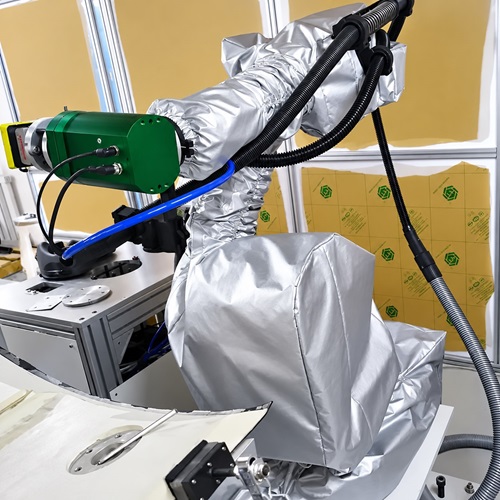
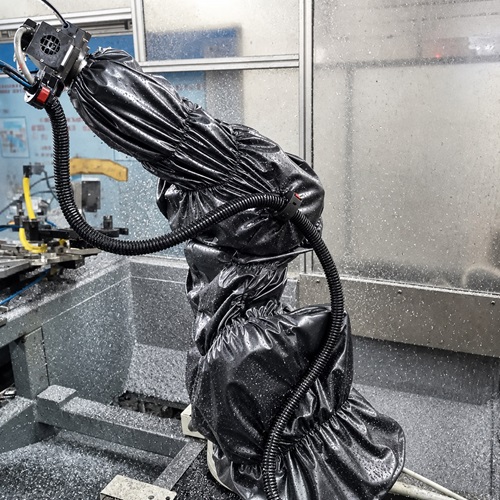
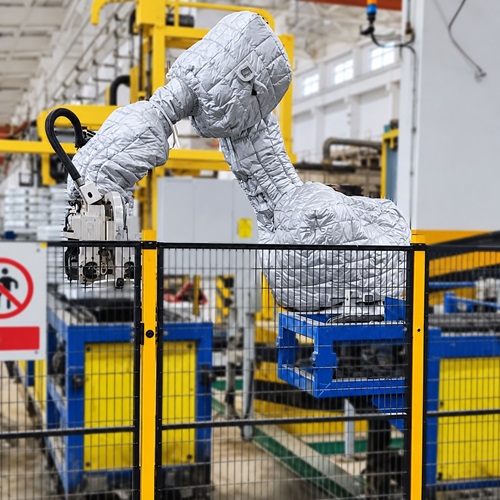
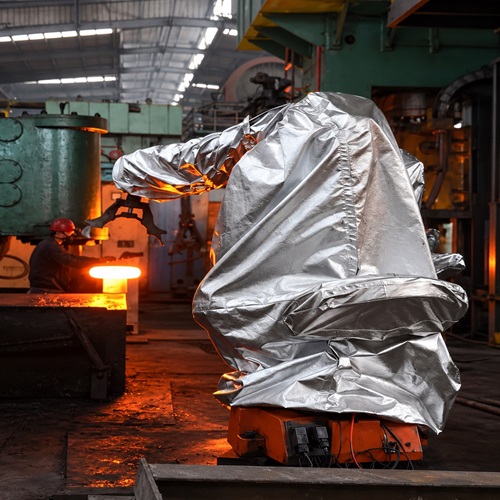
For example, robot protection in painting, welding, machining and chemical-processing environments can involve fundamentally different requirements.
The first question should therefore not be “Is this material waterproof?” but
“What does the robot need protection from?”
A heavier or thicker material is not automatically a better protective material.
Additional thickness may improve certain mechanical properties, but it can also increase weight, stiffness and resistance to movement. Around articulated joints, excessive stiffness can make it more difficult for the cover to follow repeated robot movements.
Material selection therefore requires a balance between protection, flexibility, weight and movement.
Mistake 03
Mistake 04
Expecting One Material to Work Everywhere
Looking Only at the Fabric
Painting, welding, dust, chemical exposure, wet processes and clean environments do not present the same hazards.
Their protection requirements can differ substantially.
For example, one application may prioritize resistance to contamination and electrostatic behavior, while another may require resistance to heat and welding spatter. A chemically aggressive environment introduces yet another set of compatibility requirements.
Different applications require different material properties — and sometimes different material combinations.
Even the correct fabric cannot provide effective protection if the overall cover construction is unsuitable.
Seams, closures, openings, fastening points, flexible sections and interfaces can all become weak points in the protective system.
For liquid-exposure applications, for example, the performance of seams and openings can be just as important as the material itself.
Material performance ≠ Cover performance
Mistake 05
Waiting Until the Cover Fails
Robot protective covers are wear components and should be inspected as part of routine maintenance.
Areas exposed to repeated bending, abrasion, heat, chemicals or mechanical stress may deteriorate faster than relatively static areas.
Replacement should therefore be based on the actual condition of the cover and the severity of the application, rather than waiting for major damage or protection failure.
Start with the Environment, Not the Material
A practical material-selection process begins with a simple sequence:
Operating Environment → Hazards → Protection Requirements → Material & Construction → Validation
At ROBCARE, material selection is considered together with robot movement, cover construction and the actual operating environment.
The right material is not the material with the most impressive specification — it is the material that matches the actual application.
Planning a Robot Protection Application?
Every robotic application has different movement patterns, tooling and environmental conditions. Send us your robot model, application information and available technical data, and we can evaluate the appropriate protection concept.
Custom-engineered protective solutions
for industrial robots, end-of-arm tooling
and related equipment.
√ Application-Based Engineering
√ Custom-Fit Protection
√ From Concept to Production
Billrothstraße 2A-5-34,
1190 Vienna, Austria
Tel: +43 660 5657968
© 2026 EMEDEN. All Rights Reserved. | ROBCARE™