
Cleanroom & Contamination Control
Cleanroom Robot Covers
Engineered protective covers for robotic systems operating in particle-sensitive
and contamination-controlled environments.
Designed to reduce particle release, support contamination control and maintain
unrestricted robot movement.
Low Particle Release | ESD Control | Cleanroom-Compatible Materials | Custom Fit
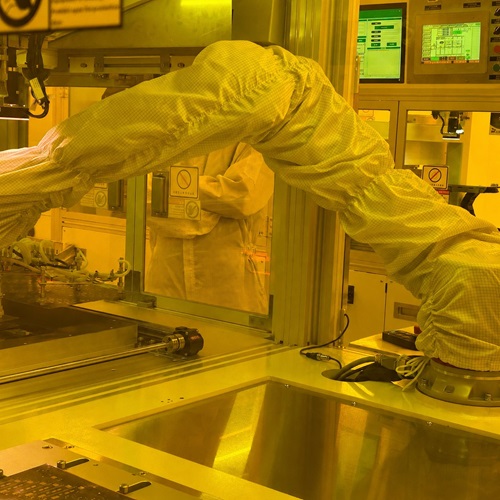
Particle Control
Helps contain particles generated by robot movement and mechanical components.
Contamination Barrier
Separates the robot body, joints and cabling from the controlled production environment.
Motion-Compatible Design
Pattern geometry and flexible sections are engineered around the robot’s working envelope.
Cleanroom Applications
Cleanroom environments place different demands on robotic protection depending on the process, contamination sensitivity and ESD requirements.
Cover materials and construction are therefore selected according to the specific production environment and required contamination-control strategy.
√
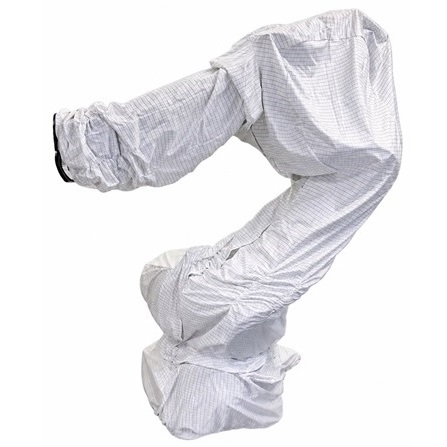
Semiconductor & Electronics
For semiconductor, electronics and other particle-sensitive manufacturing environments where contamination and electrostatic control are critical.
Particle Control · ESD · Low Lint
√
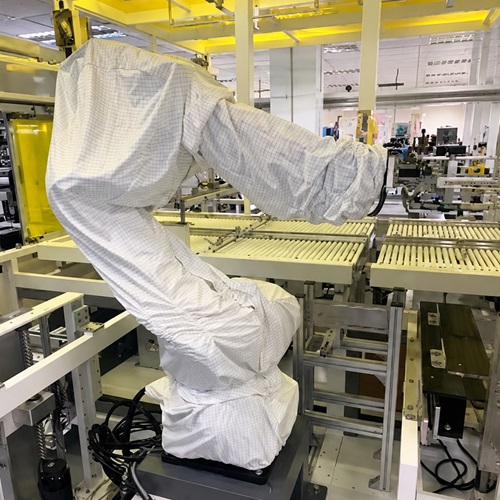
Pharmaceutical & Medical Automation
Protective covers for robotic handling and automation in controlled pharmaceutical, medical-device and clean manufacturing environments.
Contamination Control · Low Lint · Material Compatibility
√
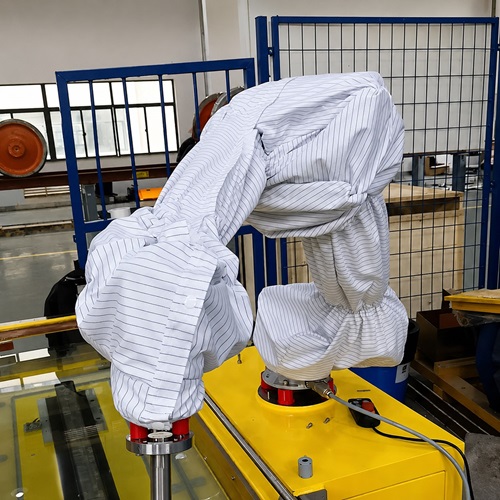
Precision Assembly
Designed for automated assembly and handling processes where airborne particles or contamination may affect product quality.
Low Particle Release · Flexible Motion · Custom Fit
What the Cover Helps Control
Particles
Helps contain particles released from robot joints, surfaces and moving components.
Lubricants & Mechanical Residues
Creates a barrier between internal robot components and the controlled environment.
Electrostatic Risk
Suitable conductive or static-dissipative materials can be selected for ESD-sensitive applications.
External Contamination
Helps reduce contamination transfer between the robot and the surrounding process area.
Materials Selected for the Process
Requirement
Design Consideration
Low Particle Release
ESD Control
Cleaning Compatibility
Mechanical Flexibility
Low-lint fabrics suitable for contamination-controlled environments
Conductive or static-dissipative materials where required
Materials selected according to specified cleaning and maintenance procedures
Lightweight, flexible constructions for repeated robot movement
√
Material specifications are selected according to the actual operating environment and customer requirements.
Engineered for Robotic Motion
√
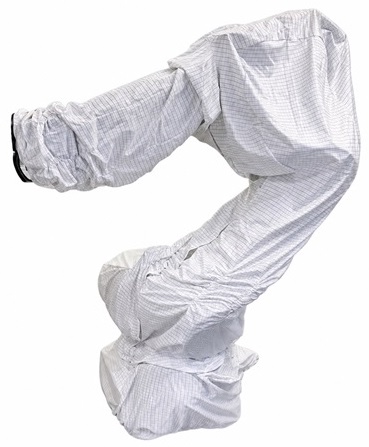
A cleanroom cover must control contamination without restricting the robot’s movement.
Cover geometry is therefore developed around the robot model, joint configuration and required motion range.
Joint Allowance
Additional volume is positioned around high-movement joints.
Flexible Sections
Gathered or articulated sections accommodate repeated bending and rotation.
Secure Interfaces
Elasticated cuffs, closures and connection points help maintain stable positioning.
Service Access
Cover construction can be adapted for installation, inspection and maintenance.
From Robot Data to Custom Fit
√
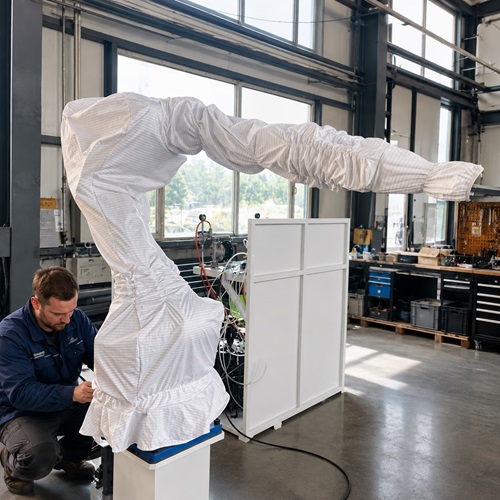
Cleanroom robot covers can be developed from robot model data,
3D geometry, photographs and application-specific motion requirements.
01
Robot Model
Robot type, configuration and working envelope
02
Process Environment
Cleanroom requirements, ESD, contamination risks and cleaning procedures
03
Cover Engineering
Material selection, pattern design and joint allowances
04
Fit Verification
Installation, movement test and adjustment
05
Production
Validated design for repeat production
Different Cleanrooms. Different Requirements.
There is no single universal cleanroom robot cover.
√
Particle-Sensitive Production
Focus on:
Low particle release
Low-lint construction
Containment of robot-generated particles
√
ESD-Sensitive Production
Focus on:
Static-dissipative materials
Conductive pathways where required
Material compatibility with ESD control systems
√
Controlled / Cleanable Production
Focus on:
Surface cleanability
Chemical compatibility with cleaning procedures
Closure and seam design
The final specification should be defined according to the production environment—not simply by robot model.
Typical Design Features
Low-Lint Materials
ESD-Compatible Options
Elasticated Interfaces
Flexible Joint Sections
Custom Closures
Replaceable / Reusable Designs
Design features are configured according to robot geometry, contamination-control requirements and maintenance needs.
Need a Cleanroom Cover for Your Robot?
Robot model · Application · Cleanroom requirements · Photos / 3D data
Send us the robot model, application environment and available drawings
or photographs. We will help evaluate the appropriate material and cover construction.
Custom-engineered protective solutions
for industrial robots, end-of-arm tooling
and related equipment.
√ Application-Based Engineering
√ Custom-Fit Protection
√ From Concept to Production
Billrothstraße 2A-5-34,
1190 Vienna, Austria
Tel: +43 660 5657968
© 2026 EMEDEN. All Rights Reserved. | ROBCARE™