
Knowledge Center
COMPONENT PROTECTION
Why Robot Axes 4–6 Require Special Protection
The robot wrist combines high-speed multi-axis movement
with close proximity to the process.
In dust- and particle-intensive applications, effective protection
must control contamination without restricting motion.
Axes 4–6 form the wrist section of a typical six-axis industrial robot. These joints control much of the orientation and positioning of the end-of-arm tooling.In applications such as material removal, machining and other particle-generating processes, the wrist operates close to the source of contamination and may be repeatedly exposed to dust, fine particles and process residues.
At the same time, this is one of the most dynamic areas of the robot.
The protection challenge is therefore not simply to cover the wrist — it is to protect it while preserving its full range of movement.
01
Proximity to the Process
02
Multi-Axis Movement
The Wrist Operates Close to the Contamination Source
Protection Must Follow the Wrist — Not Restrict It
The robot wrist and end-of-arm tooling are normally the parts of the robotic system closest to the workpiece and the production process.
Depending on the application, this area may be exposed to:
In material-removal applications, contamination may be generated continuously while the robot is operating.
This makes the wrist area particularly important when defining the overall robot protection concept.
The closer a robot component operates to the process, the more carefully its actual exposure should be evaluated.
dust and fine particles
abrasive residues
metal particles and machining debris
oil mist and process contamination
splashes and other production residues
Axes 4, 5 and 6 do not move independently in a simple linear direction. Their combined rotation continuously changes the geometry of the wrist and the orientation of the tooling.
This creates a demanding environment for a protective cover.
If the cover is too tight, repeated movement can create excessive tension around seams, joints and fastening points.
If it is too loose, excess material may fold unpredictably, shift position or interfere with nearby components.
The protection therefore needs controlled flexibility and sufficient movement allowance in the correct locations.
03
Structural Design
Flexible Sections Must Be Positioned Where Movement Occurs
A robot protective cover does not need the same amount of flexibility everywhere.
Relatively stable areas can use simpler cover geometries, while highly articulated areas may require additional material allowance, gathered sections or other flexible structures.
The position of these flexible sections should correspond to the robot's actual movement.
Flexibility should be engineered into the cover where the robot needs it — not added uniformly across the entire structure.
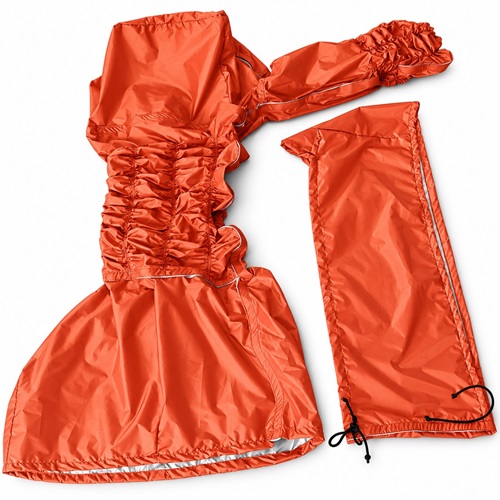
Flexible and gathered sections provide movement allowance around highly articulated robot areas.
04
Material and Structure Work Together
05
Installation and Validation
Material Selection Alone Is Not Enough
A Wrist Cover Must Be Checked in Motion
A suitable material is important, but material properties alone do not determine whether a wrist protection system will work.
The design must also consider:
contamination + movement + cover geometry + seams + fastening + maintenance
A material with suitable resistance may still perform poorly if the cover construction creates excessive tension or allows contamination to enter through critical interfaces.
Conversely, a well-designed structure cannot compensate for a material that is unsuitable for the operating environment.
Material and structural design must therefore be evaluated as one protection system.
Correct installation is part of the protection concept.
After installation, the robot should be moved through the relevant operating positions to verify that:
A cover that appears correct while the robot is stationary may behave very differently once Axes 4–6 begin moving together.
Wrist protection should therefore be validated dynamically — not only in the robot's home position.
the intended areas remain covered
the cover follows joint movement correctly
excessive tension does not develop
uncontrolled folding does not occur
cables and hoses remain free to move
the end-of-arm tooling is not obstructed
fastening points remain stable
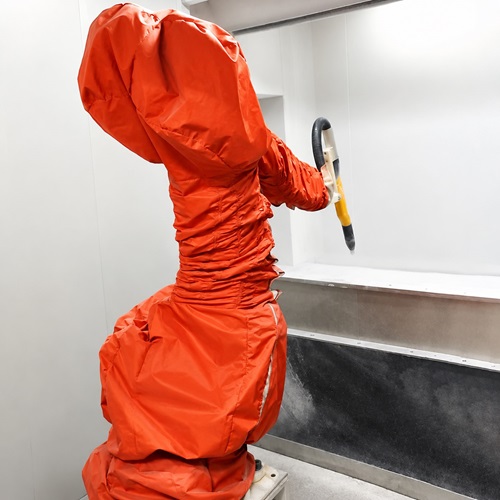
Kawasaki RS010N in a Particle-Intensive Process
The Kawasaki RS010N is a six-axis industrial robot designed for a wide range of applications, including material handling, machine tending, sealing and dispensing, assembly and material removal.
In particle-intensive processes, a protective cover can provide an additional barrier between the robot and contamination generated by the application.
The example shown here illustrates an important design principle: the cover must protect the robot while still accommodating the complex movement of the wrist
and the attached tooling.
The robot model defines the movement geometry. The application defines the hazard. The protective cover must respond to both.
Protect the Wrist as Part of the Moving System
Axes 4–6 should not be treated simply as another area to be enclosed.
Their combination of frequent movement, changing geometry and proximity to the process makes wrist protection a specific engineering challenge.
At ROBCARE, wrist protection is considered together with the robot model, movement pattern, tooling, operating environment and maintenance requirements.
Effective wrist protection keeps contamination away from critical robot areas while allowing the robot to move exactly as the application requires.
Planning a Robot Protection Application?
Every robotic application has different movement patterns, tooling and environmental conditions. Send us your robot model, application information and available technical data, and we can evaluate the appropriate protection concept.
Custom-engineered protective solutions
for industrial robots, end-of-arm tooling
and related equipment.
√ Application-Based Engineering
√ Custom-Fit Protection
√ From Concept to Production
Billrothstraße 2A-5-34,
1190 Vienna, Austria
Tel: +43 660 5657968
© 2026 EMEDEN. All Rights Reserved. | ROBCARE™