
Knowledge Center
PROTECTION DESIGN
Why Static Robot Dimensions
Are Not Enough for Protective Cover Design
Effective robot protection must account for
movement, joint articulation, cable routing and tooling —
not just static dimensions.
Static Fit Does Not Mean Dynamic Fit
A cover may appear to fit perfectly when the robot is stationary. However, once the robot begins operating, the situation can change considerably.
During rotation, extension and complex multi-axis movements, different areas of the cover are repeatedly stretched, compressed and folded.
If insufficient movement allowance has been incorporated into the design,
this can lead to:
excessive tension on the fabric and seams
interference with robot movement
concentrated wear around joints
unwanted material accumulation
displacement of fastening points
premature tearing or loss of sealing performance
A cover that fits well while the robot is parked may therefore perform poorly during actual production.
A robot protective cover cannot be designed solely around the robot’s dimensions in a stationary position.
While static dimensions provide an important starting point,
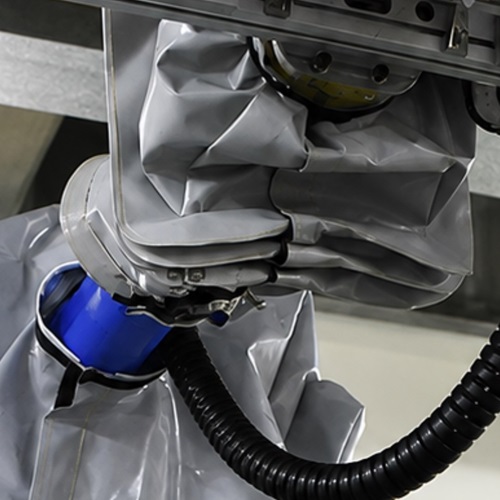
an industrial robot changes its geometry continuously during operation. Joints rotate, arms extend and retract, cable packages move, and end-of-arm tooling may significantly alter the space required around the robot.
For this reason, an effective protective cover must be designed around the robot’s complete working movement —
not simply its static shape.
The Complete Working Envelope Matters
Before developing the cover structure, the robot's operating movements should be evaluated across the relevant production cycle.
Particular attention should be given to areas where the protective material must accommodate large changes in geometry, especially around rotating joints, articulated sections and transition areas between robot axes.
The objective is not simply to make the cover larger.
The objective is to provide movement allowance in the right locations.
Too little material can restrict movement and create excessive tension.
Too much material can create folds, interfere with surrounding equipment or increase wear.
Cables and Tooling Move Too
The robot body is only part of the system.
Cable packages, hoses, dress packs, grippers, welding guns and other end-of-arm tooling may move together with the robot and can substantially influence
the protective cover design.
Their movement should therefore be considered when determining:
local clearances
flexible sections
openings and interfaces
fastening positions
reinforced areas
cover segmentation
This becomes particularly important when cables or hoses pass through or underneath protected areas.
Critical Areas Require Specific Structural Solutions
Not every part of a robot cover experiences the same mechanical stress.
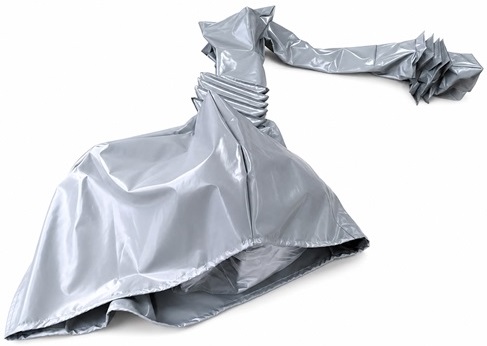
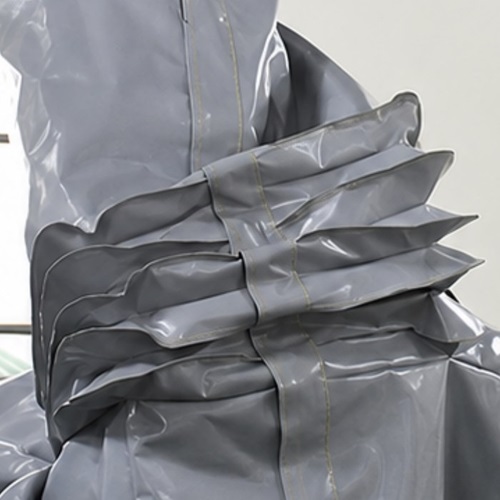
High-frequency bending areas, joints, cable transitions and tooling interfaces can require different structural solutions from relatively static sections.
Depending on the application, these may include flexible sections, bellows-type structures, reinforced seams, adjustable fastening points or
separately removable cover sections.
For wet or liquid-exposure environments, these structural decisions are especially important because repeated stretching or displacement can
eventually create openings through which liquids can reach the robot.
Design for the Robot in Operation
A successful robot protective cover should therefore be based on more than a dimensional drawing.
Static dimensions remain important, but they should be combined with information about the robot model, operating sequence, working envelope, cable routing, tooling configuration and actual environmental hazards.
At ROBCARE, we consider the protective cover as part of the moving robotic system rather than as a static enclosure.
This approach helps achieve the real objective of protective cover engineering:
Maintaining effective protection throughout the robot's operating cycle without interfering with its movement or production process.
Planning a Robot Protection Application?
Every robotic application has different movement patterns, tooling and environmental conditions. Send us your robot model, application information and available technical data, and we can evaluate the appropriate protection concept.
Custom-engineered protective solutions
for industrial robots, end-of-arm tooling
and related equipment.
√ Application-Based Engineering
√ Custom-Fit Protection
√ From Concept to Production
Billrothstraße 2A-5-34,
1190 Vienna, Austria
Tel: +43 660 5657968
© 2026 EMEDEN. All Rights Reserved. | ROBCARE™